Use of external antennas and propagation
Unless you have no problem achieving the data rate you desire with just the bit of copper trace in your wire less USB-Modem you may have a need for an external antenna. If you live not in direct Radio Line Of Sight to the Antenna of your Net-provider, you can try to improve the situation with an external antenna. However between an antenna and the modem you have connectors and cable which will add attenuation and may offset the gain you expected to get with using an external antenna. A bad antenna design makes things even worse by adding more loss due to miss-match. At worst loss may offset the gain of the antenna, but using a directional antenna reduction of e.g. multipath can still improve your situation for other reasons if not for gain.
Lossless cable, high quality connectors and a good (high) gain antenna are the best and cheapest RF amplifier! to improve any RF-linkNot only cable but also a connector and missmatch in impedance between antenna, connector and cable will add to the overall attenuation. At worst the gain that one would hope to achieve by using an external antenna will be compensated by high loss e.g. in RG-174 cable , to 0 dB.
Impedance-Missmatch- & coax-cable loss: In order to achieve low loss between the connector of the stick, the cable and the antenna all have to have the same impedance. You may have heard of 75 Ohm for TV and 50 Ohm for communication, but also 60 Ohm or other values can be found. Any mismatch in Impedance will increase losses. While for the Huawei or other sticks you find at best the connectors or adapter-cable you can only improve it for the rest of the connection to the antenna.
Assume we have such an adapter or with antenna attached that uses RG-174 coax-cable. The attenuation per 100 m RG174 cable is ~92 dB/900 MHz and 145 dB @1800 MHz. If you had a 7 dBi gain with 4 m RG-174 coax-cable then the effective gain would be 0 dBi since antenna gain and cable loss would compensate each other. A semirigd coaxcable of about the same diameter has a about 60 dB/100m lower at 1000 MHz then the RG-174 (Semi-rigid 141CU-W-P-50 ~37 dB/100 m @1000 MHz compared to ~98 dB/100m @1000 MHz). Unless you want to permanently fix the cable (semi-rigid cable should be bend only once, and observing the allowable raidius) a short piece of semirigid with an reliable connector like SMA and then a thicker low loss cable should be used all the way to the antenna input. While much thicker good cable starts at about 1/4" in diameter e.g. 1/4" Cellflex or a bit more flexible like Aircom +. Again all coaxcable have restrictions on the radius you can bend them or roll them.
Connector-loss: The attenuation loss increases if connector have not been designed for more then just a a few disconnects to the stick, e.g. those connectors used in Notebooks for WLAN are mostly rated just for a few disconnects. Beyond the specified connections the loss will increase.
The solution would be to permanently fix an adapter-cable from the small connector to the internal connector soldered on the PCB to a solid reliable connectors like SMA. The cables in between should be as short as possible, because even thin flexible Teflon-cable or semi-rigid cable have a quite some loss around 900 MHz and even more around 2000 MHz. Connectors, adapter and antenna can be now found at may stores. The connector used by Huawei is called
CRS-5001-xxx http://www.smk.co.jp/p_file/TS5e_20080919.pdf or CRC-9 in some shops. Some shops like the vendor mentioned below also offer antennas, but mainly for the range around 2000 MHz. In case you ever read through HAM-radio literature on antennas most of them will look familiar. However for Do It Urself (DIU) an antennas you will have to scale the measurements of antenna to the desired frequency band (e.g. 900 MHz), since measurements in HAM-literature are always for the HAM-Bands (e.g. 23 cm or ~1250 -1300 MHz).
Antenna: You have to know in which frequency band your node is operating and find one just for that frequency. Multiband antenna with higher gain are much more complicated to design then antennas for a single frequency band.
On the positive side you will need only one band to achieve the Data Link (DL) and therefore a single band antenna to optimize the link to a node to achieve operation. To give you an idea the size/gain of a commercial omni-directional antenna, it's 3,8 m for 9 dBi at 960 MHz, which is why most antennas available are optimized for around 2000 MHz or WLAN. At around 2000 MHz the wavelength will reduce the size by about factor of 2 compared to around 900 MHz, but the gain for a scaled down antenna at 2000 MHz will be a bit lower.
Those having the chance to mount a satellite dish of at least 0,9 m diameter may try fixing the stick at the location where the LNB mounting was removed. Since the internal design of the antenna are not known to me no guidance for the best placement in the center of the parabolic dish can be given at that point, however this approach help improve in some cases devices operating on 2.45 MHz like AV-transmitters. Before you use a to high gain antenna be sure to check what restrictions on the EIRP exist in your country and remember that the EIRP is lower the the gain of the antenna plus the output power of the stick because the cable loss will reduce it by a few dB.
Antenna bandwidth: As the impedance has to be constant in a system another factor is the antenna bandwidth. If the antenna is not matched to the impedance of the system within the frequency segment that the base-nodes and your modem transmit and receive you will have additional loss.
Propagation:- Polarization: Most antenna used for communication, navigation and surveillance use either horizontal (h) or vertical (v)polarization including TV-satellites. Since in principle the decoupling between h & c is 20 dB e.g. TV-satellites use overlapping channels but with alternating polarizations. In reality I had cases at VHF when the decoupling was down to 6 -7 dB.
The choice is made based on the best propagation if all factors like multipath e.g. to reflection on ground or terrain are considered. In some cases also a mix of both polarizations are used, which are then called circular when h&v have identical strength or elliptical if h & v have different strength.
- Multipath- and -polarization-effects:
Whenever you receive in addition to the signal originating from the transmitter but also numerous reflections, more or less delayed from the direct signal, you call this multipath. Multipath may in part or at worst completely make the signal undetectable. A change of location with will in- or de-crease the distance to the reflecting object and therefore will reduce or worsen the undesired effect. Furthermore the impact will vary with the signal waveform (Modulation characters), which may not have to be worse when a different more complex waveform is employed. UMTS may be the favorite for the next time to come also around 900 MHz if sharing criteria and agreements will be made. While max. data transfer is of our concern you have to consider also moving/flying applications and you should know that waveforms have different susceptibilities e.g. due multipath and doppler-effects, and therefore limitation as to the max. speed they may be used with successfully.
Even if you have direct Radio Line Of Sight (RLOS) to the transmitter you may experience a fluctuation in signal. Fast, if moving objects may interfere/reflect, several seconds, minutes to hours e.g. if weather, growth of surface or buildings are involved. I experienced also change a slow change of polarization while beeing within RLOS to the transmitter.
Propagation is a confusing and complex field, which is why the coverage charts of your provider are at best a good guess and not reliable document. Without a defined antenna, and I don't consider the short pieces of cooper trace on the PCB or pieces of plastic and reliable antenna. On the other hand that's why many HAM-operators find their hobby so fascinating. Tthere are still many effects unknown and are still under study.
You can improve your signal strength considerable for a few € with a bit of hardware, if you built yourself a a good antenna. A good antenna will improve if not the signal strength the reliability of your link.
_ . . . . _ . . . . . . . _ _ . _ . _ _ ;-)
Material & Links to more information on antennas and prorogation
Links to HAM clubs and their publications Please note the HAM community is an official ITU-Radio-Serveice and has a number of frequency bands starting from shortwave 80 m ~3.5 MHz into the up to >10 GHz available. Only part of the information can therefore be relevant to 900 MHz and 2000 MHz range you are interested in, but since the information is mostly not on the accademic level you will find them an easy and informative read.
www.dubus.org HAM's that are interested in VHF and higher frequencies , in addition to DIU equipment also antenna and propagation is covered in their publications. Scan of some older publications available.
www.arrl.org the US HAM-club publishes their paper QST but also also books e.g. focussing on antennas.
www.darc.de is the German HAM-club publishes their montly paper CQ-DL and some books e.g. focussing on antennas.
www.rsgb.org.uk the UK HAM-club publishes their monthly paper RAD-COM and some books e.g. focusing on antennas.
www.csse.monash.edu.au/projects/MobileComponents/wlan/public/software/antguide.pdf While making reference to comercial antennas a not to detailed sumary, noteworthy are the calculations for a linkbudget at the end.
antenna diversityAntenna diversity, also known as space diversity, is any one of several wireless
diversity schemes that use two or more antennas to improve the quality and reliability of a wireless link. Often, especially in urban and indoor environments, there is not a clear
line-of-sight (LOS) between transmitter and receiver. Instead the signal is reflected along multiple paths before finally being received. Each of these bounces can introduce phase shifts, time delays, attenuations, and even distortions that can destructively interfere with one another at the aperture of the receiving antenna. Antenna diversity is especially effective at mitigating these
multipath situations. This is because multiple antennas afford a receiver several observations of the same signal. Each antenna will experience a different interference environment. Thus, if one antenna is experiencing a deep fade, it is likely that another has a sufficient signal. Collectively such a system can provide a robust link. While this is primarily seen in receiving systems (
diversity reception), the analog has also proven valuable for transmitting systems (
transmit diversity) as well.
Inherently an antenna diversity scheme requires additional hardware and integration versus a single antenna system but due to the commonality of the signal paths a fair amount of circuitry can be shared. Also with the multiple signals there is a greater processing demand placed on the receiver, which can lead to tighter design requirements. Typically, however, signal reliability is paramount and using multiple antennas is an effective way to decrease the number of drop-outs and lost connections.
[more at Wikipedia...]The chart below shows the effect of diversity on data throughput dependant on distance from the NodeB (cell tower):
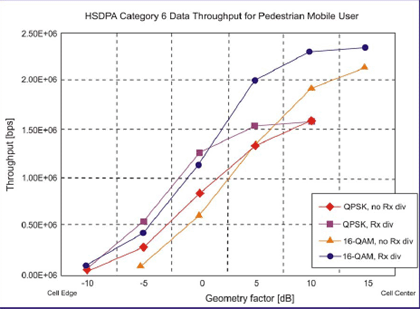 (QPSK and 16-QAM are both modulation schemes used on HSDPA-networks)source: http://www.mobilehandsetdesignline.com/howto/189800068connector types
for an overview of 3G-connector types see http://www.brennpunkt-srl.de/geraeteliste%20UMTS.html
vendors - Brennpunkt SRL, a Romanian company founded by German engineer Friedrich Rappl, offers cheap customizable (connector type, cable length) 2G/3G antennas with high build quality.
- Nu am semnal .ro, Bucharest, Romania based distributor of GSM /3G /UMTS /HSDPA yagi and panel antennas, cable, connectors and repeater/amplifiers.



 Share this


